


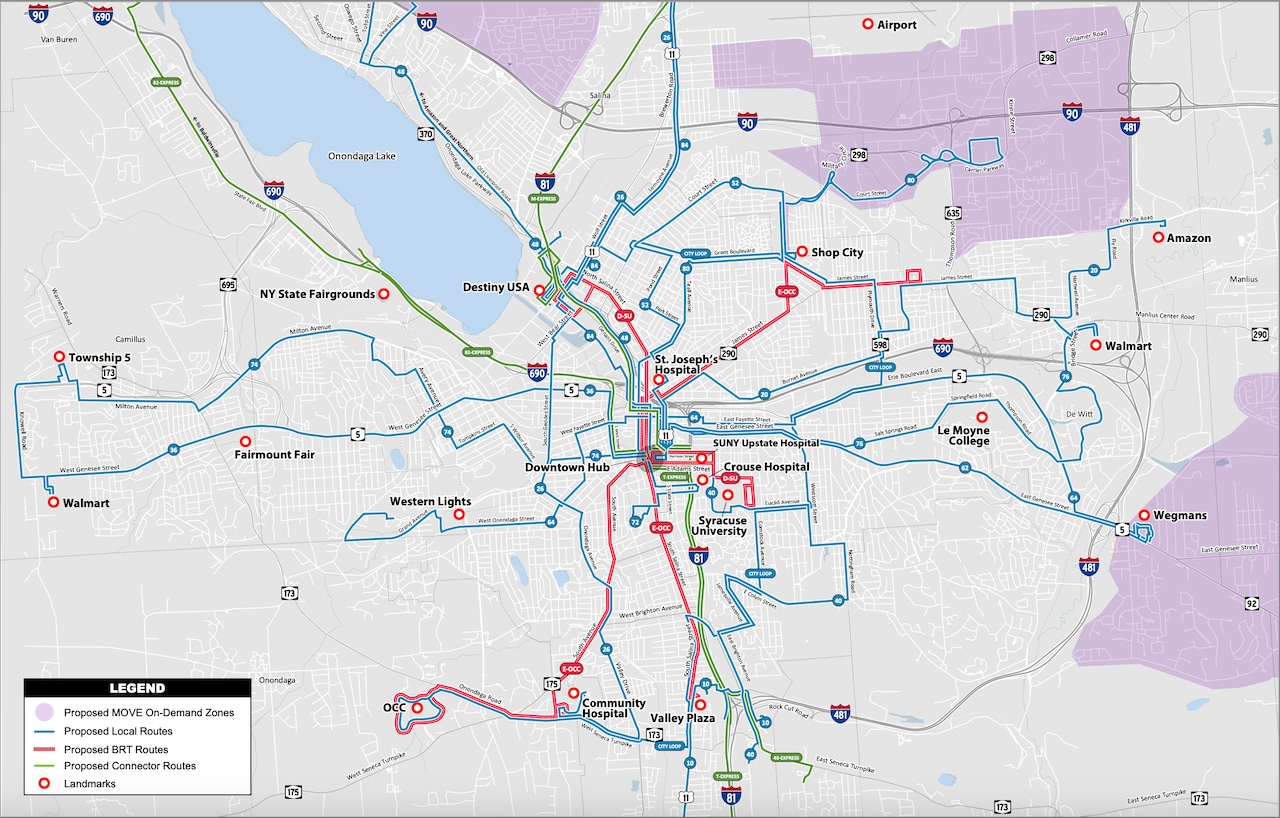
Syracuse, N.Y. -- Centro is redesigning its bus routes across Onondaga County, adding service in the city and some northern suburbs but consolidating and eliminating trips in eastern towns.
The proposal is the system’s first overhaul in more than two decades. The goals include putting more buses on key routes on weekdays and decreasing wait times at bus stops, especially in the city. The plan would add service along Route 31 and streamline rides to major employers like Amazon, Walmart and Wegmans north of Syracuse.
But the new design would consolidate and cut seven routes overall. Under the current proposal, Centro’s service in Onondaga County would go from 27 routes to 20.
The decreases in traditional bus service would be mainly in three areas: east of the village of Liverpool, in Manlius and Fayetteville, and around Carrier Circle, which has the county’s largest concentration of hotels and hotel workers.
Some of these routes are being combined. In most cases, riders in these areas would no longer use traditional bus routes. Instead, Centro would create new zones with an on-demand service, which could cost more.
The redesign comes as Centro’s ridership is down from nearly a decade ago. Ridership plummeted 70% during the pandemic. It’s back up to 5.9 million annual rides, though still down from 8.1 million in 2019.
At the same time, almost 1 in 10 city residents use Centro, spokesman Steven Koegel said.
That’s why one of the main goals includes beefing up service along downtown Syracuse routes, a move intended to speed up pickups and shorten wait times at those bus stops by as much as half, he said. Bus routes serving the city’s busy James Street corridor would merge to funnel more buses more often on that commute.
That means changing, and eliminating, some traditional routes in the suburbs. Instead, Centro would provide an on-demand service, called MOVE, in three zones:
- Fayetteville and Manlius
- East of Liverpool in parts of Salina and Clay
- Around Carrier Circle
As part of the redesign, Centro spoke with employers about the route changes, including FedEx, Micron, Amazon, Loretto and the Syracuse Airport, he said.
The goal is to implement the changes beginning in 2027.
This overhaul is separate from Centro’s plans to build a bus rapid transit system, three routes that would serve Syracuse riders like above-ground subway lines. But those BRT mega-lines were taken into consideration when redesigning the more traditional bus routes, Koegel said.
The price of a basic ride in Onondaga County would remain at $1, Koegel said. The price of the on-demand service hasn’t been set but would likely be more, he said.
Overall, more buses would run along many remaining routes, mostly during the peak hours from about 6 a.m. to 6 p.m. on weekdays. That would increase service hours by approximately 23%, Koegel said. The buses will still roll out at 5 a.m. and come to a stop around midnight, seven days a week.
It’s an $800,000 redesign that Centro has been working on since 2024.
Right now, nothing is final, and Centro is soliciting feedback from riders. You can see how your bus route would shift on Centro’s website. If you see something that you’d like to change, you can email betterbus@centro.org, contact Centro on social media @gocentrobus or call customer service.
Centro aims to finalize a draft of the route changes by mid-December for internal review. The public would be able to weigh in at a hearing early next year.
Here are more details about the proposed changes in key areas:
Syracuse
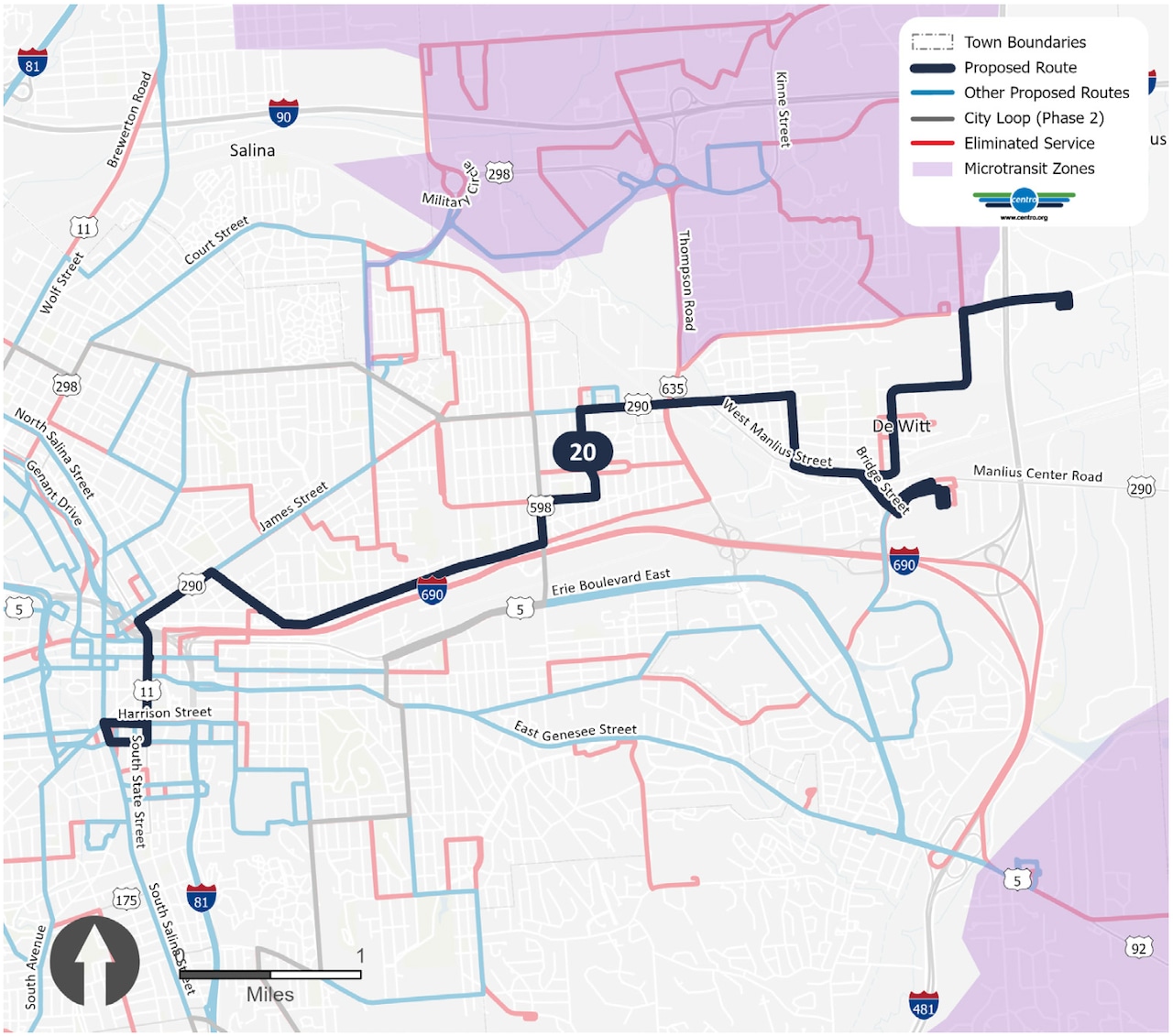
Under the proposal, buses would come more often to the stops in the city.
Now in downtown Syracuse, routes operate every 40 minutes. Centro is trying to make this faster, so that buses come every 20 to 30 minutes.
This includes buses that run along South Avenue and Salina, James and Court streets.
Historically, James Street has always been the busiest corridor in the system. People have taken the SY20 route along this street over 300,000 times since last November, Koegel said. The plan is to combine the three routes that currently serve that area into one route, so that more buses can pick up riders more frequently.
The James Street redesign would make it easier for Eastwood residents to get to grocery stores like Tops in Shop City. The increased frequency along Salina Street would also help riders travel from the downtown Centro hub to Valley Plaza more often.
The routes that serve Syracuse University, Upstate Medical University, Crouse Hospital and University Hill would mostly remain unchanged with this redesign. But riders on these routes should also have shorter wait times. With BRT coming in the future, the goal is for university and hospital riders to be able to catch the bus every 12 to 15 minutes, Koegel said.
Liverpool, Mattydale, Salina and Clay
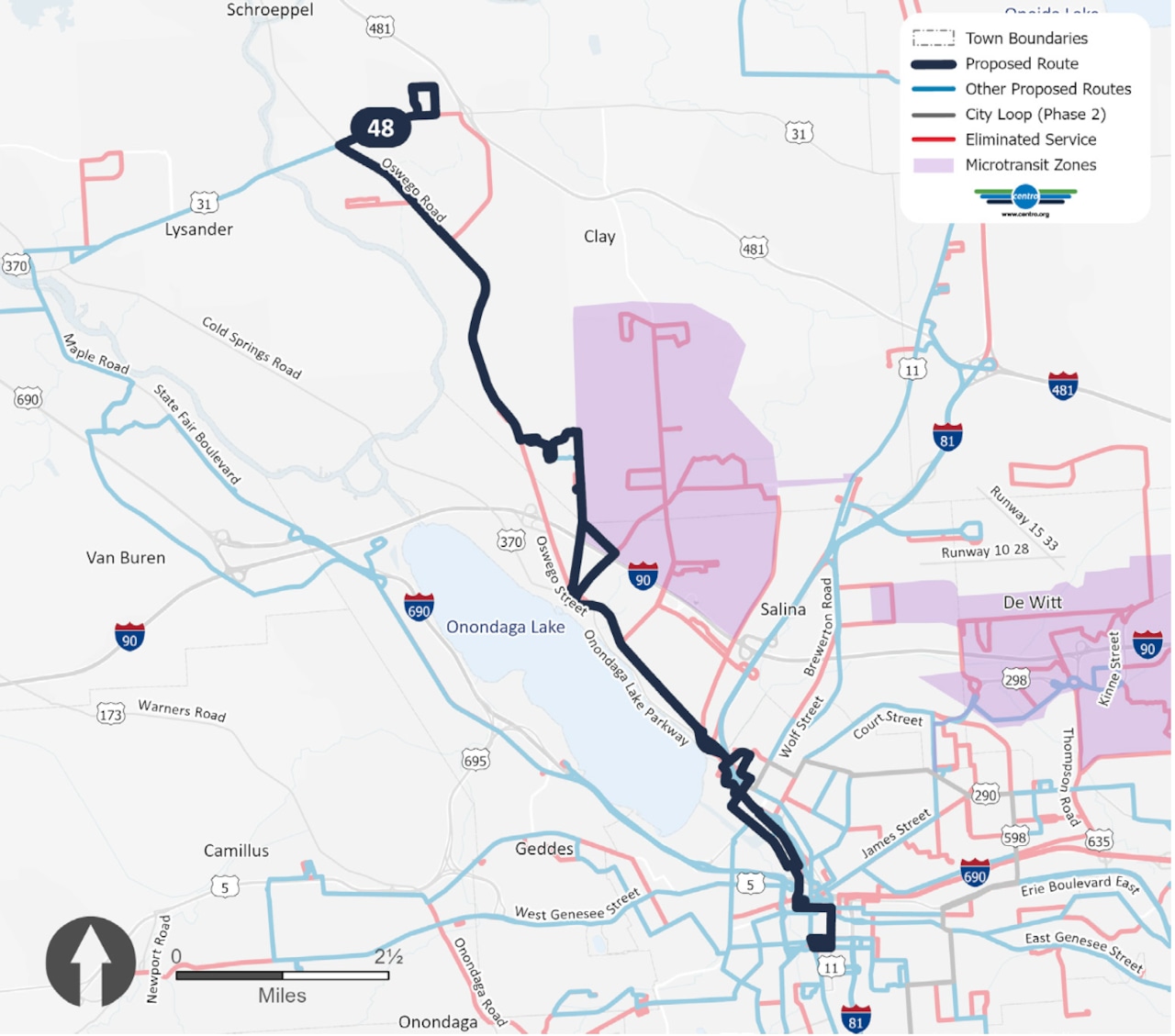
The proposed changes in Liverpool would involve consolidating two routes into one that would connect the downtown hub to Destiny USA, through Liverpool, past Amazon on Morgan Road and out to the Wegmans and Walmart along Route 31 in Clay.
It would help riders get from the downtown Centro hub to their jobs at Raymour & Flanigan, Amazon and Verizon in those northern communities, Koegel said.
This combined route would run more frequently than any of the existing routes in that area, Koegel said. And when workers are changing shifts, more trips would operate directly from the downtown Centro hub to Amazon.
“These aren’t jobs where you can do it remotely. These are hands-on jobs where you have to be there to do your job,” Koegel said. “That is a prime location of where we knew we had to serve.”
But the current route, SY86, that serves Morgan Road and Buckley Road north of the Amazon Fulfillment Center, would be cut.
“That part of the route didn’t perform well,” Koegel said. “So we eliminated that part of the route from a fixed route standpoint.”
Instead, the new on-demand service, MOVE, would provide rides for people in that zone, where over 26,000 residents live. (See more information about MOVE below.)
Fayetteville and Manlius
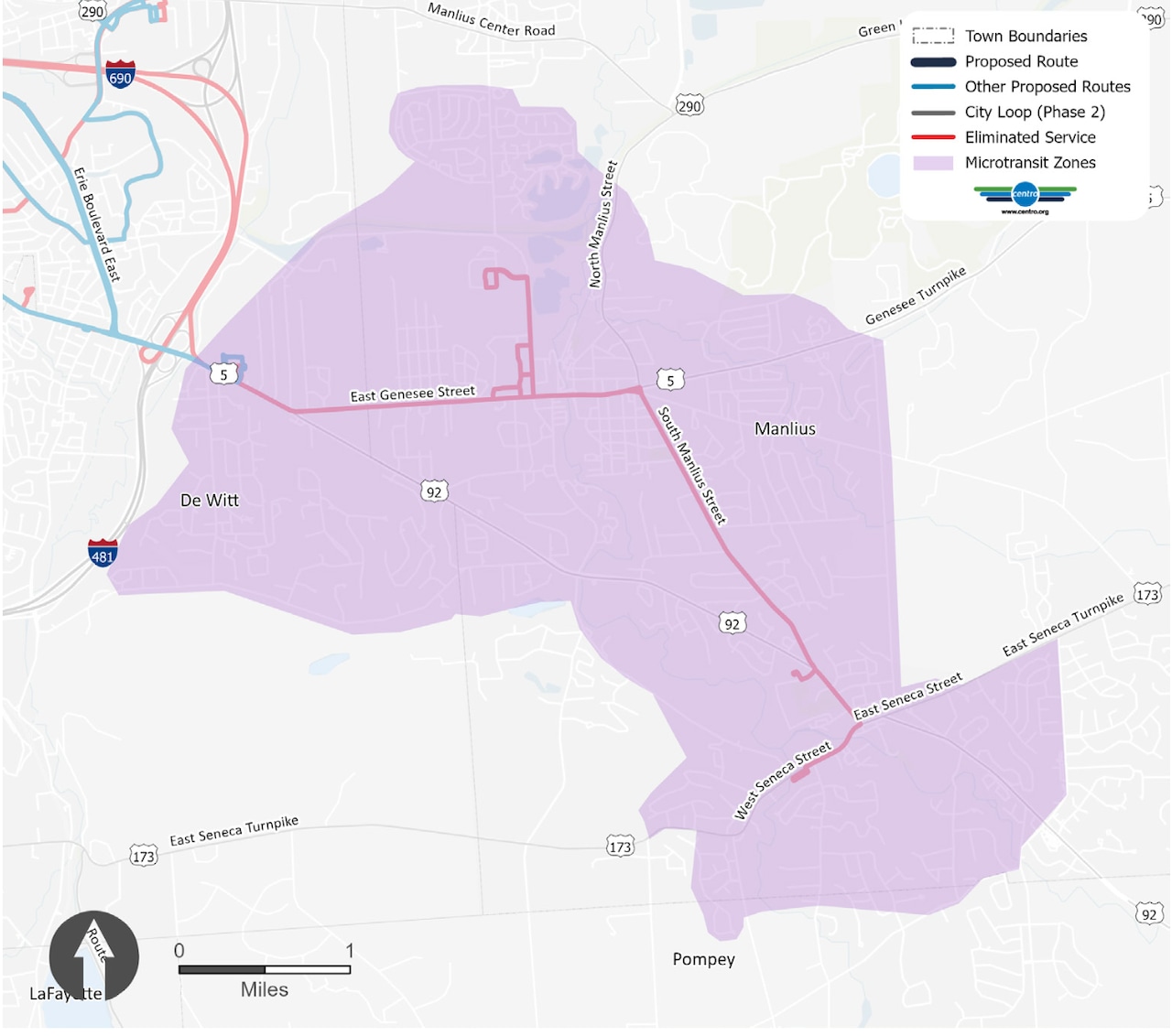
The eastern suburbs would see some of the biggest changes when it comes to eliminating routes. Instead, many of these riders would need to use the MOVE on-demand service.
The current route that goes out to Fayetteville is SY62. One key stop along the way is at Towne Center at Fayetteville. The proposed new route would end at the Wegmans in DeWitt, meaning no fixed bus route out to Tops, TJ Maxx, and Target at Towne Center.
But this change is still under consideration, Koegel said. Riders have already reached out to Centro, saying they still want a bus that goes out to Towne Center.
That would mean adding 30 minutes of travel time to this route under the new configuration, he added. That would limit how often it could run.
Koegel said that many people who depend on Centro are located closer to downtown.
The new on-demand zone proposed for this area would be where more than 22,000 residents live.
Carrier Circle
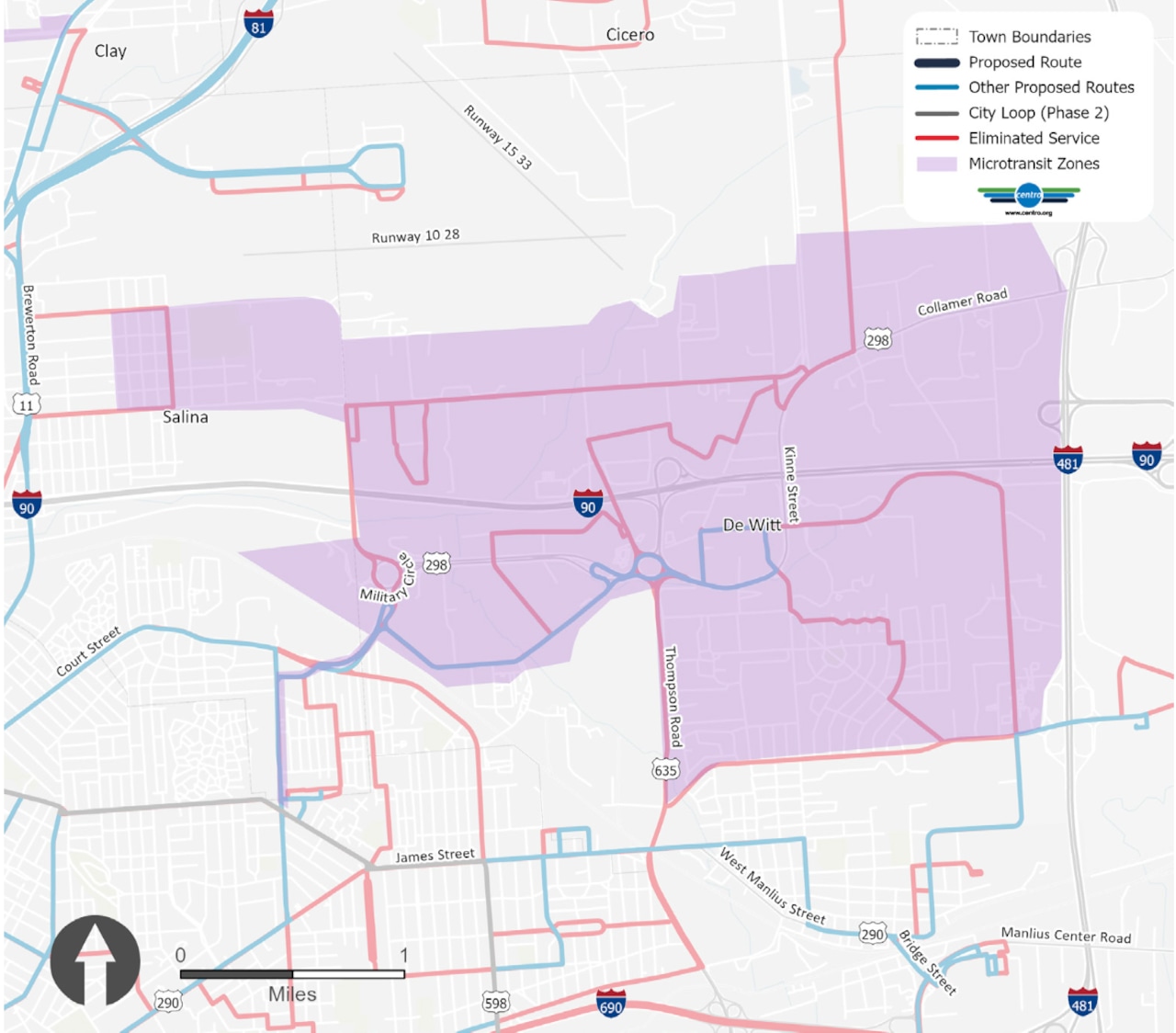
Three routes that currently serve Carrier Circle -- SY20, SY52 and SY58 -- would no longer go to that area. That means these riders would also have to use the MOVE on-demand service.
Those buses now have few riders, Koegel said.
It’s a challenge to service this area, he added. Riders’ homes and workplaces are spread out. Hotel workers have varying shifts. It’s difficult to serve so many work schedules with fixed-route service, he said.
Instead, Koegel said, these riders could also use MOVE, which would be available for the 12,192 residents in this area.
MOVE: On-demand rides
Centro would create three on-demand zones for the areas where regular service would be cut: around Carrier Circle, in Fayetteville and Manlius, and in parts of Salina, on the edge of Liverpool, near Henry Clay Boulevard.
MOVE would be a new type of Centro bus that riders could call through an app on their phone. It’s based on the same service that Centro tested in Rome, which has proved popular. Ridership there is up 22% from last year, Koegel said.
MOVE rides in Rome cost more, as much as $4.
Centro is still deciding the hours and the cost for MOVE in the three new zones in Onondaga County, Koegel said.
Here’s how it would work:
For riders who want to travel within any MOVE zone, they would call a bus using the app. An on-demand bus would pick them up at a location close to their original location and drop them off near their destination.
If riders need to get beyond the zone’s boundaries, they would have to call the bus from a location inside the MOVE zone, take it to the boundary and then connect to a traditional bus on a fixed route.
It would work the same in the opposite direction. If riders need to travel into a MOVE zone from outside of the zone, say from downtown into Carrier Circle, they could take the fixed route as far as it goes and then call a MOVE bus for the last leg of the trip.
The app pairs riders with other people who are headed in a similar direction, Koegel said.
Centro is still determining how many buses to get for MOVE. Each new bus would cost $145,000.
Ongoing plans for BRT
Centro still plans to launch eleven new buses for a Bus Rapid Transit system in Onondaga County in 2028, which would cost $30 million to $35 million to implement.
These routes would cross the city in an X shape and take riders to popular destinations along Centro’s most crowded bus routes.
One route would go from Onondaga Community College to Eastwood. Another route would travel from Syracuse University to Destiny USA, along the north side through downtown. The last bus route would run along Salina Street and jog back and forth from the Centro hub to Valley Plaza.
The goal of BRT is to move riders quickly throughout the city with limited stops, Koegel said.
The BRT buses would run every 12 to 15 minutes, which means riders could catch them faster and more often.
Each bus costs approximately $1 million.
The bus shelters along the BRT routes would also have special features: real-time information signs, so riders could see when the next bus is coming, and they would be larger than the standard Centro bus shelters.
Koegel expects there to be 65 of these new bus shelters when BRT debuts.
What’s next?
Now, Centro is still in the community engagement phase, and is even implementing some suggestions now before the big overhaul.
For example, Centro just decided to increase frequency during the morning in Camillus, so riders can get to their shifts more often. Centro made this change after riders requested more service, Koegel said.
Riders can contact Centro with feedback like this through email betterbus@centro.org, by phone 315-442-3333, or on social media @gocentrobus.
The goal is to have a finalized proposed plan that Centro can review internally by mid-December.
The public will also be able to comment at a hearing during the first quarter of next year.
After public hearing, the Centro board plans to vote on the redesigned routes in spring of 2026.
Then, Centro would have nine months to get everything ready for the buses to run on the new routes at the beginning of 2027.