
The American Civil Liberties Union of New York has asked a federal judge to unseal documents that would show how the federal government got one of the warrants that resulted in the largest immigration raid this year in Upstate New York.
Magistrate Judge Therese Wiley Dancks granted two warrants in August and has closed the case to the public. Documents under seal would reveal the argument Homeland Security agents made to win the judge’s blessing to enter a Cato nutrition bar factory in early September.
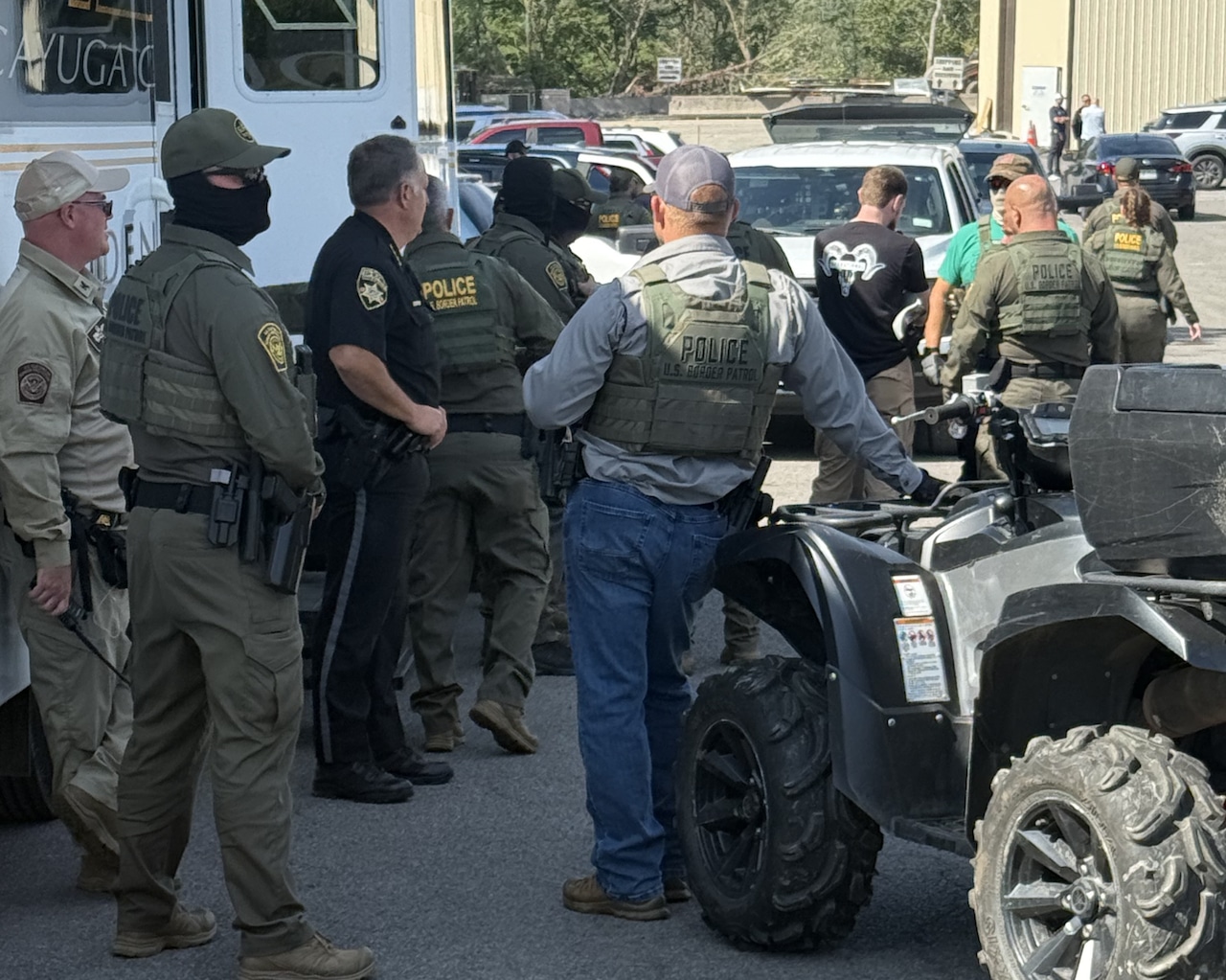
Federal agents, with support from sheriff’s deputies in Cayuga and Oswego counties, swarmed the plant, broke down doors and herded workers into a break room.
Witnesses described it as a “massive military-style assault” by about 75 law enforcement agents bearing machine guns and coming with dogs, trucks, vans and dune buggies, the ACLU said in its motion.
Nearly 60 workers were detained. Many were deported before they could speak with attorneys. At least 21 people were separated from children, including three under the age of 2.
Five workers were charged with a felony immigration charge. One, Argentina Juarez-Lopez, has asked the judge to suppress the evidence in her case because, her attorney says, the government used the wrong kind of warrants to enter the factory.
The ACLU says one of the warrants, nicknamed a “Blackie’s” warrant, is not to be used for a criminal investigation. The civil warrant allowed a search of documents - employee files and bank statements - that could be evidence of employing unauthorized workers.
It did not show probable cause to search or detain a person. No one is named in the warrant.
For that reason, Perry Grossman, a lawyer for the ACLU in New York, says the raid violated the Fourth Amendment to the Constitution.
A second warrant issued the same day is a criminal warrant related to identity theft and the unlawful use of Social Security numbers. It generally describes a search of records on the 80-acre property, but does not name an individual. It also likely overstepped the law if it was used as justification to round up workers, Grossman said. But the use of an administrative warrant is especially problematic, he said.
Even the ACLU’s motion to unseal the records is under seal. The ACLU shared a copy with syracuse.com | The Post-Standard.
“The aggressive tactics used on Sept. 4 are incongruous with the limits courts to date have placed on the executive of administrative search warrants and raise serious concerns about the representations made to the magistrate judge in applying for the warrants,” Grossman wrote in his motion.
He said it is of “exceptional public concern” whether the government sought to convert a narrow administrative search warrant into an authorization for mass detention.
Federal judges in Texas earlier this year denied federal agents’ application for the same kind of administrative search warrant in an immigration case, saying “people are not documents or safety hazards.”
These warrants are nicknamed “Blackie’s warrants” because of a 1981 case in Washington, D.C. that allowed one to be used for a worksite inspection related to an immigration raid.
The Texas judges said the case law that supported Blackie’s is no longer relevant. At the time, employing undocumented workers was not a crime. So using an administrative warrant would not have resulted in criminal charges.
The ACLU also argues for the release of documents because “little about the raid or its targets remains secret.”
Acting U.S. Attorney John Sarcone has publicly acknowledged the raid, the related criminal investigation, arrests and detentions and warned that similar actions should be expected in the future, the motion said.
Unsealing the record is also in line with the First Amendment, which guarantees the public access to judicial records.
“Public access to warrant papers plays a significant positive role by enabling the citizenry to monitor the government’s exercise of its extraordinary search-and-seizure powers and to deter its abuse,” the motion said.
Because the warrant was for administrative investigation rather than a criminal investigation, the release would not jeopardize any criminal investigation or the privacy rights of any defendant, the motion said.
“Instead, unsealing will illuminate how the request for civil administrative entry and search authority was presented to and constrained by the court, and will allow the public to assess whether the government’s intrusion was justified, the motion said.
More immigration coverage
- Public has right to know what feds said to get warrant for Cato immigration raid (Editorial Board Opinion)
- Border Patrol monitoring millions of US drivers for ‘suspicious’ travel patterns
- See inside immigration raid at Cato factory as agents bust into bathrooms, sort workers (video)
- Reactions to ‘When ICE came for Jeremy’: Staying on expired visa has consequences (Your Letters)
- Catholic leaders — including Syracuse’s bishop — issue rare ‘special message’ that condemns Trump’s deportations